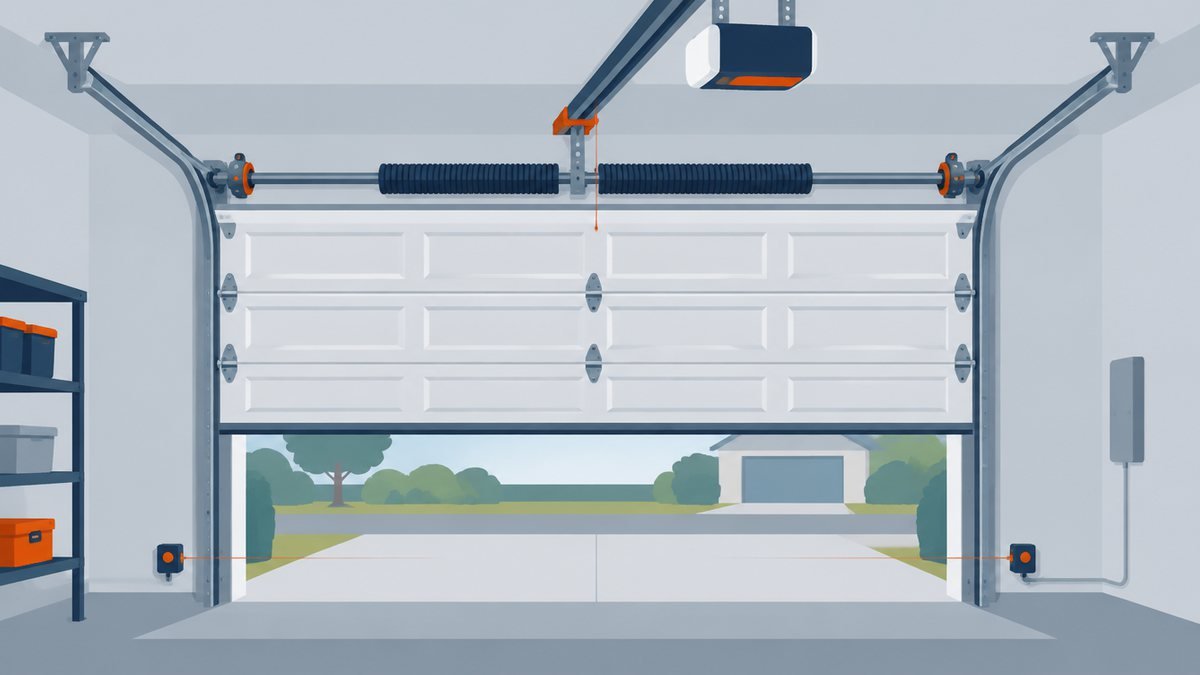
A heavy garage door is held up by springs under tension, guided by tracks and cables, and moved by an opener that is built to help, not to lift the whole load alone. When something goes wrong, the symptom you see is often several steps away from the cause.
This guide sorts garage door problems by what the door does, so you can tell which ones are safe to check yourself and which ones are not. It draws on opener owner’s manuals, the federal Consumer Product Safety Commission (CPSC) and the safety guidance of two opener makers. Our guides to garage door springs, garage door openers and garage door sensors go deeper into each area.
Sort the problem first
Start with a simple question: what does the door do when you press the button? The answer points to one of four groups, and each group has its own safe checks.
Nothing happens when you press the button
If the opener does not respond at all, the cause is usually at the power or control end, and these checks are safe.
- Power. Check that the opener is plugged in and that the outlet has power.
- Remote battery. One Chamberlain manual says that when the remote’s battery is low, the remote’s LED will not flash when you press the button. If the wall control works and the remote does not, start with the battery.
- Lock feature on the wall control. The same manual tells owners whose remote will not work to confirm that the wall control’s lock feature has not been switched on.
- A manual lock on the door. Opener makers say to disable all locks on the door before operating the opener, because a locked door can stop it from moving.
If none of these helps, the opener may have a fault of its own. Our guide to opener repair covers what an owner can check there.
The opener runs but the door does not move
If you hear the motor and the door stays where it is, the opener may have lost its connection to the door. Openers have an emergency release, usually a rope with a handle, that disconnects the carriage from the door so it can be moved by hand.
An opener manual warns that the release handle should be used only when the door is closed, if possible, because the door can fall when it is disconnected. It also says the handle should be mounted at least 6 feet above the floor, away from vehicles, so it is not caught by accident. If the door is closed and the release was pulled, the manual for your opener explains how to reconnect it.
Stop there if anything looks wrong with the door itself. An opener manual lists a broken spring among the causes when a door stops or reverses. One opener maker’s guidance is blunt: do not operate the door, either by hand or with the opener, if it has a broken spring, and contact a professional dealer. Releasing the door and trying to lift it by hand in that state is not a safe test.
It will not close and the opener lights flash
This is the most common symptom with an easy fix. Opener makers build in safety sensors, also called safety reversing sensors or photo eyes, that send an invisible beam across the doorway near the floor. If the beam is blocked or the sensors do not line up, the door will not close.
One Chamberlain manual describes the behavior: if something blocks the beam or the sensors are out of line as the door closes, the door reverses and the opener lights flash ten times. With the door already open, it will refuse to close. The manual’s fix is to realign both sensors so that both LEDs are steady and not flickering, and to make sure nothing hanging on the door interrupts the beam. The same manual describes the sending sensor as having an amber LED and the receiving sensor a green LED.
Other points from the manuals:
- The sensors should be inside the garage, one on each side of the door, no more than 6 inches above the floor, facing each other with the lenses aligned.
- The receiving sensor lens should not get direct sunlight.
- A wire to a sensor that is cut or loose has the same effect as a blocked beam.
Do not tape over or bypass a sensor to get the door to close. Our guide to garage door sensors explains how they work and what the lights mean.
The door reverses or stops on the way down
A door that closes and then goes back up, or that stops without reversing, can be a sensor problem, an opener setting or a mechanical problem. Sort them in this order.
- Check the sensors. A closing door that reverses without touching anything is often a sensor beam that was broken for a moment.
- Look for an obstruction. A door lock, a bent track or a loose item in the path can make the door stop or reverse.
- Think about the opener’s settings. Opener makers say travel limits and close force must be set before the reversal test. If the door does not reverse when it touches the test board, one manual says to increase the down travel, and another says to lower the close force.
- Check the balance. An unbalanced door may not reverse when required, and that is why a balance problem is a safety problem as well as a mechanical one.
If the door still fails after the manual’s steps, call a trained door systems technician. For doors that close and then reopen, see our garage door closes then opens guide.
The door is heavy, crooked, noisy or binding
When a door is hard to lift by hand, hangs crooked, rubs or makes new noises, the cause is mechanical, and this is where owners should stop. The opener manual says to always call a trained door systems technician if the garage door binds, sticks or is out of balance.
Opener makers describe a balance check that is safe on a door whose springs look intact. With the opener disconnected, lift the door halfway and let go. A balanced door stays where it is, held up entirely by its springs. One maker says to raise the door 36 inches and says a door that drifts more than a few inches either way is not properly balanced. Do not try this on a door with a broken spring, a door that has come off its track or a door that feels heavy as you lift it. Never adjust the springs yourself to fix a balance problem. Our garage door balance guide explains what the test shows.
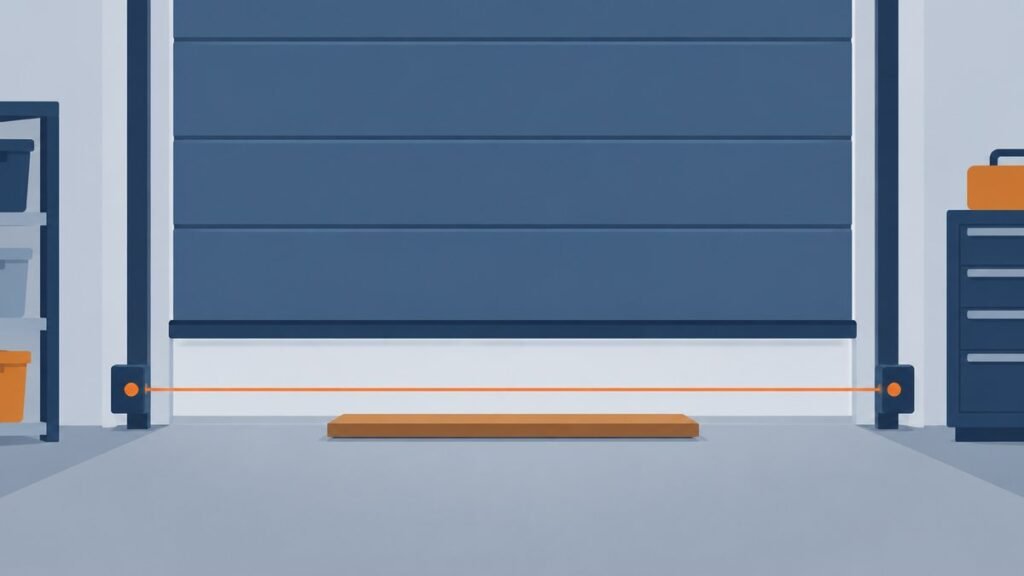
An opener manual says any gap under the door must not exceed 1/4 inch, or the reversal system may not work as it should, so a worn or damaged bottom seal matters for safety. It also says to oil door rollers, bearings and hinges every year, and not to grease the tracks. See our garage door maintenance checklist for the routine.
The two tests to do every month
Opener manuals and the federal safety agency are clear that the reversal tests are not optional. One manual says the reversal system must be tested monthly and after any adjustment, because without it a closing door could seriously injure or kill a person, especially a small child. Federal rules require that the door reverse on contact with a 1 1/2 inch high object, or a 2×4 laid flat, on the floor.
- Contact reversal test. With the door open, lay a 2×4 flat on the floor in the center of the doorway and close the door with the wall control. The door must reverse when it touches the board. One opener maker says it should reverse within 2 seconds. If it does not, follow your manual’s adjustment steps and repeat the test. If it still fails, that maker says you may need to replace the opener.
- Sensor test. With the door open, put an object such as a carton in the path of the beam and press the button. In one Chamberlain manual, the door moves no more than an inch and the opener lights flash ten times.
The CPSC said in a 1990 advisory that at least 45 children between 2 and 14 had died between March 1982 and June 1990 after being trapped under closing garage doors that did not reverse. Our garage door safety tests guide walks through them in more detail.
Quick reference
| What you see | Safe checks | Call a professional if |
|---|---|---|
| Opener is dead | Power, outlet, remote battery, lock feature on the wall control | The wall control and remote both fail and power is fine |
| Motor runs, door stays | Whether the emergency release was pulled | A spring, cable or track looks damaged |
| Lights flash, door will not close | Sensor alignment, steady LEDs, anything blocking the beam | Wiring to a sensor is damaged or the door still will not close |
| Door reverses or stops | Sensors, obstructions, manual’s travel and force steps | The door fails the reversal test after the manual’s steps |
| Door is heavy or crooked | Look only. Do not adjust anything | The door binds, sticks, is out of balance or is off its track |
When to call a professional
Call a trained door systems technician for anything involving springs, cables, drums, brackets, a door that is off its track, a door that will not hold its position when lifted halfway or an opener that fails the reversal test after you follow your manual. Garage door springs and cables are under so much tension that opener makers tell owners never to loosen, move or adjust them. Our guide to garage door springs explains how they work and why only a professional should touch them.
The short version
- Sort the problem by what the door does: dead, motor only, lights flashing or heavy and crooked.
- Power, remote batteries, the lock feature and sensor alignment are safe checks.
- Do not bypass the sensors. They are one of the two systems that stop a closing door.
- Test the reversal system every month with a 2×4 laid flat and the sensors with an object in the beam.
- Never touch springs, cables or brackets. A broken spring means no operating the door, by hand or by opener, until a professional has looked at it.
Frequently asked questions
Why won’t my garage door close and the opener lights flash?
Usually the safety sensors are misaligned or something blocked the beam. One Chamberlain manual says to realign both sensors until both LEDs are steady, and to check that nothing hanging on the door interrupts the beam.
Why does my garage door go back up after closing?
The opener thinks something is in the way. That can be a blocked or misaligned sensor, a binding door or a setting for travel or close force. Check the sensors first and follow your opener manual for the settings.
Can I fix a garage door spring myself?
No. Opener makers tell owners never to loosen, move or adjust springs, cables, pulleys or brackets, which are under extreme tension. A trained door systems technician should do any spring work.
How often should I test my garage door opener?
Every month. One opener manual says the safety reversal system must be tested monthly and after any adjustment, using a 2×4 laid flat on the floor in the path of the door.
What should I do if my garage door has a broken spring?
Do not operate the door by hand or with the opener, and call a professional. One opener maker says not to operate a door that has a broken spring.
Sources
The opener troubleshooting steps and safety warnings come from opener owner’s manuals and manufacturer safety guidance. The reversal rule and the child-safety history come from federal sources.
- Chamberlain Group, Garage Door Opener Owner’s Manual (Models B503 and B500)
- Chamberlain Group, Garage Door Opener Owner’s Manual (Model HD420EVM)
- Garage Door Opener Safety | The Genie Company
- How to Test the Reverse Safety Systems of Your Genie Garage Door Opener | The Genie Company
- To Save Lives Homeowners Should Replace Non-Reversing Garage Doors | U.S. Consumer Product Safety Commission
- 16 CFR 1211.16: Installation and Operation Instructions for Garage Door Operators | Legal Information Institute